Every logistics manager knows the feeling. October hits. Order volume triples. Your distribution center runs three shifts instead of one. And about two weeks into the surge, the scanner batteries start dropping like flies. The ones that held a full charge just fine in August are suddenly dying by lunchtime. Nobody planned for this. Nobody budgeted for it. And now you are paying overnight shipping on battery orders while your pickers stand idle.
This pattern is not about bad luck. It is about how lithium-ion batteries age in the real world, and how "was fine last season" is the single most misleading indicator of battery health you can use. Here is what actually happens under the hood, and what you should be doing right now — before the rush starts — to avoid the predictable meltdown.
A Battery That Sat on a Shelf for Six Months Is Not the Same Battery
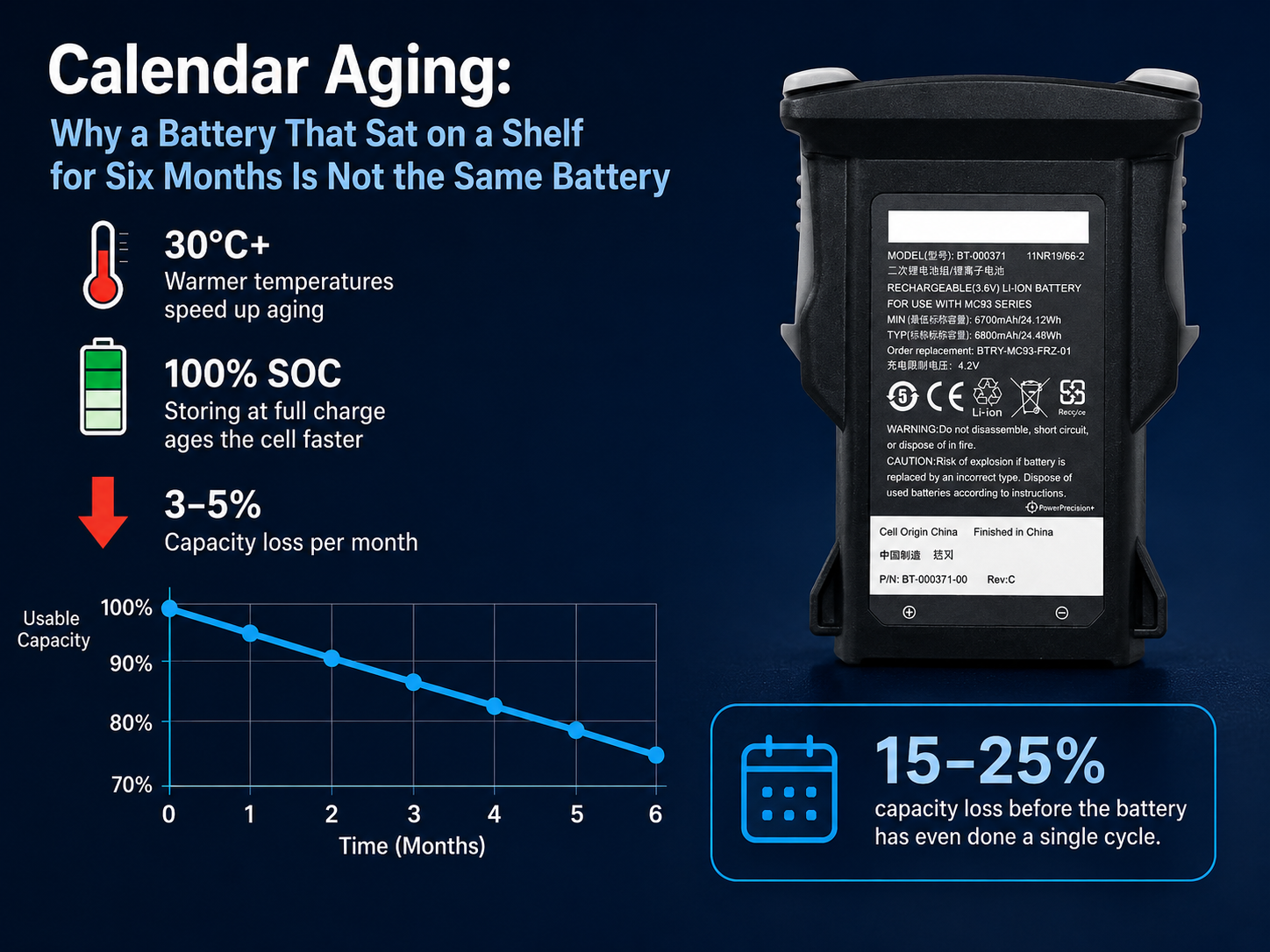
Lithium-ion cells do not just degrade when you use them. They degrade when you do not use them either. It is called calendar aging, and it happens faster at high state-of-charge and in warm environments.
Take a scanner battery that was pulled off the charger at 100% in April and tossed in a cabinet in the warehouse office. By October, it has spent six months sitting at full charge in ambient temperatures that probably hit 30°C or higher through the summer. Calendar aging at 100% SOC and 30°C can knock 3 to 5% off the usable capacity per month for some chemistries. That is somewhere between 15% and 25% capacity loss before the battery has even done a single cycle.
Now add the fact that the internal resistance has crept up as well. Higher IR means more voltage sag under load — the scanner draws a current spike every time the laser fires or the screen refreshes, and if the voltage dips below the device's brownout threshold, you get a reboot or a shutdown even though the battery gauge still says 30%.
The battery worked fine in April. In October, it technically still works. It just works for four hours instead of eight. That is not a failure. That is predictable degradation, and it is why "checking the batteries two weeks into peak" is a losing strategy.
The Pre-Season Battery Audit Nobody Runs but Everybody Should
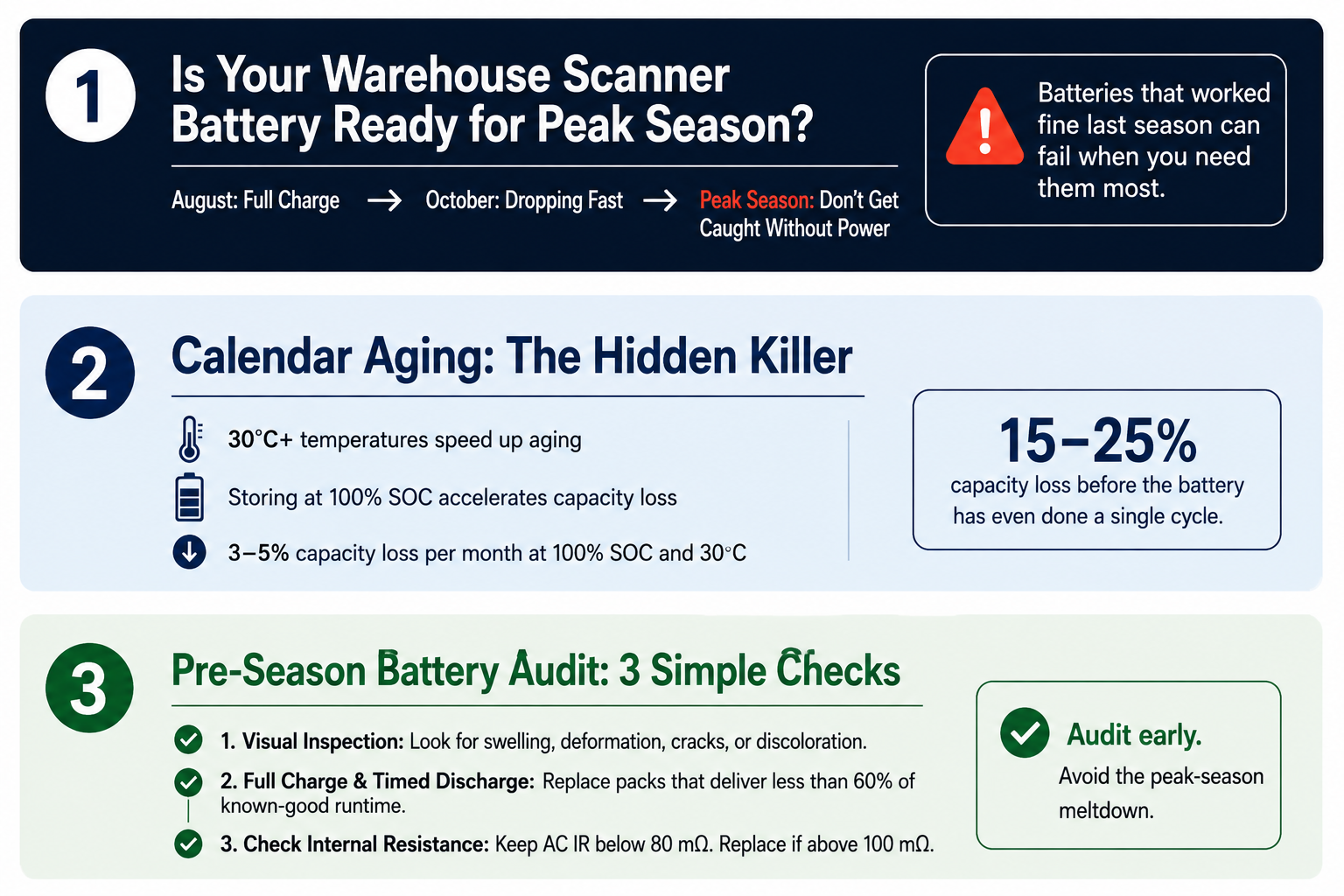
Six to eight weeks before your peak season starts, pull every spare battery out of storage and run a three-step check. It takes about two days per batch and costs nothing but time.
Step one: visual inspection. Look for swelling. A lithium pouch cell that has puffed even slightly is done — no exceptions, no "maybe it will be fine." Cylindrical cells in hard cases are harder to spot, but any deformation in the plastic housing, any cracking around the latch points, or any discoloration on the contact pads is a red flag. Swelling means gas buildup from electrolyte decomposition. The battery still works right up until it does not, at which point it can rupture.
Step two: full charge and timed discharge. Charge the battery to full. Put it in a scanner. Set the scanner to continuous scan mode if the device supports it, or run a barcode scanning app that keeps the laser active. Start a timer. You are not looking for the exact runtime — you are looking for packs that die in less than 60% of the runtime of a known-good battery of the same model. Those packs are candidates for replacement. They will not make it through a peak-season shift.
Step three: check the internal resistance if you have the equipment. A basic four-wire AC milliohm meter costs under $100 and will tell you more about battery health in five seconds than a full charge-discharge cycle. A healthy 18650 cell should measure under 50 milliohms AC IR. Above 80 milliohms, you will start seeing voltage sag issues under load. Above 100, replace the pack.
Building a Rotation That Prevents Calendar Aging
The single simplest thing you can do to extend fleet battery life is stop storing packs at 100% charge. Lithium-ion cells are happiest at roughly 40 to 60% state-of-charge for long-term storage. At that level, calendar aging slows to a crawl.
Here is a system that costs nothing to implement. When a battery comes off a scanner at the end of a shift, do not put it straight on the charger. Leave it at whatever state-of-charge it landed at — typically 20 to 40% — and only charge it right before the next shift. If your operation runs continuously, this is harder to do, but even reducing storage SOC from 100% to 80% makes a measurable difference. Some charger docks have a "storage charge" mode that charges to roughly 50 to 60%. Use it for any battery that will sit idle for more than two weeks.
When Bulk Replacement Beats Piecemeal Purchasing
If your audit turns up 30% or more of your fleet batteries near end-of-life, buying replacements one at a time as they fail during peak season is the most expensive way to solve the problem. Overnight shipping on small-quantity orders, premium pricing on single-unit purchases, and the operational cost of unplanned downtime add up fast.
Running the numbers on a fleet of 200 scanners in a mid-size DC, assuming $60 per OEM pack and a 30% failure rate mid-season: 60 units × $60 = $3,600 in hardware cost, plus roughly $25 per failure event in soft cost (worker idle time, supervisor escalation, procurement triage) = another $1,500. Total: about $5,100, and that is before factoring in the morale cost of a team that spent two weeks scrambling.
Bulk-ordering 60 quality aftermarket packs at $22 per unit, delivered two weeks before peak, brings the hardware cost to $1,320 with zero mid-season failure events. Even if two or three packs out of the batch have early issues — which a reputable supplier will warranty-replace — you are coming out ahead by thousands and avoiding the operational chaos entirely.
What to Do Right Now
Pull the batteries. Run the visual check, the timed discharge, and if you can, the IR check. Flag anything below 60% of expected runtime. Build a list. Place one order. Sleep better in October.
*Shenzhen Sunwind Energy Tech Co., Ltd. supplies replacement lithium-ion battery packs for enterprise barcode scanners, mobile data terminals, and POS equipment. Our packs use grade-A cells and are cycle-tested to 500 cycles at 0.5C before release. Bulk pricing and pre-season audit support available. Contact us for sample requests and fleet assessment assistance.*